



ECONOMY:
Oklahoma City’s economy continues to build on a foundation
of diversity and growth. Unemployment sat at 3.6% in Q1 — well below the
national average — while job creation outpaces the broader U.S. market.
Competitive state incentives, a skilled workforce, and low operating costs
support the business climate, and the city’s economic base now extends
well beyond energy into aerospace, technology, and manufacturing. Major
employers include Devon Energy, Continental Resources, Love’s Travel Stops
& Country Stores, Paycom, Tinker Air Force Base and the State of Oklahoma.
Population trends reinforce the outlook. Unlike many peer metros, Oklahoma
City continues to grow, adding roughly 8,300 residents in Q1 2026 alone — a
signal of sustained long-term appeal to both businesses and new residents.
DEMAND:
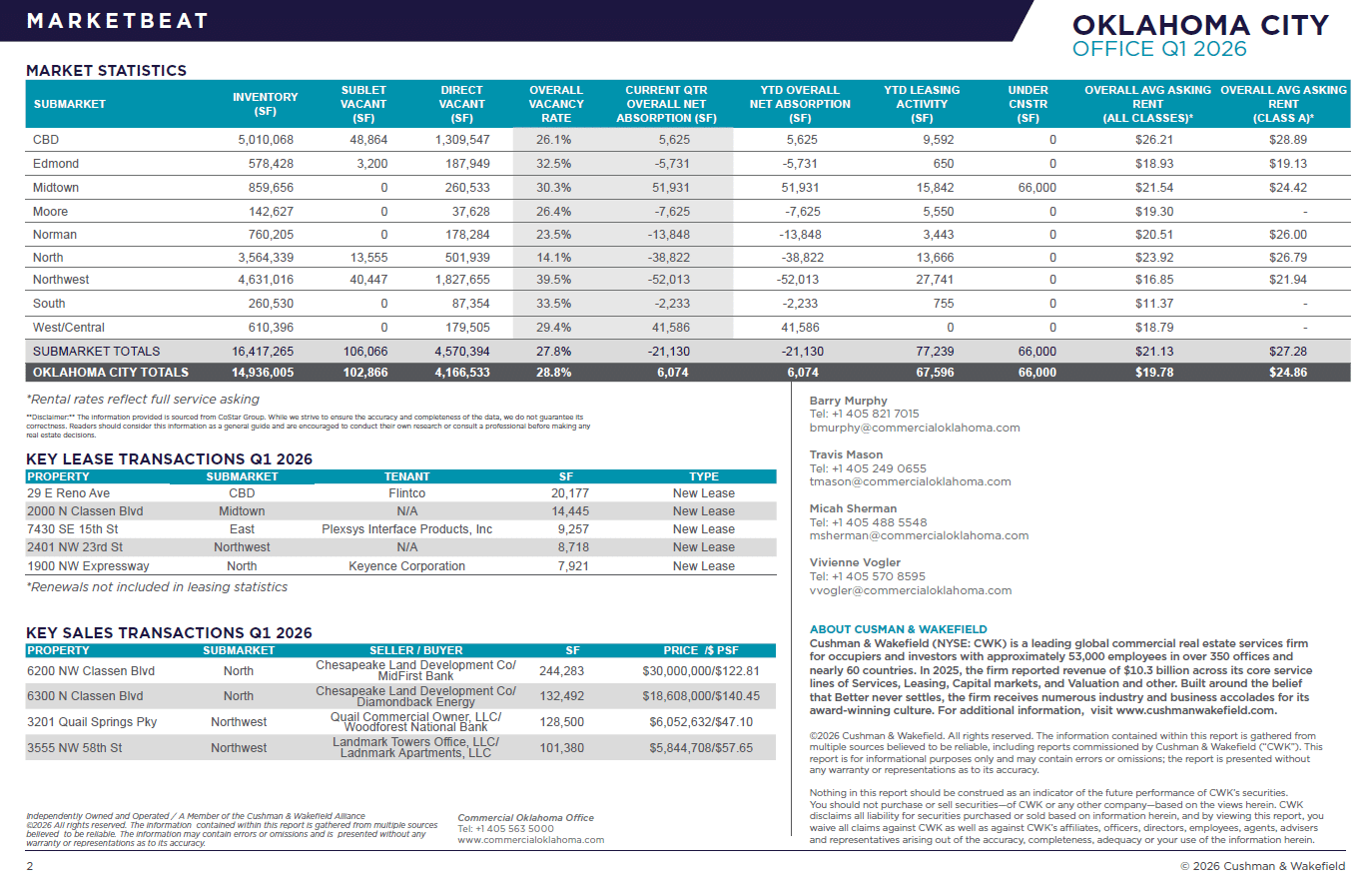
The Oklahoma City office market has held up well, driven
by measured supply growth and a steady tenant base. The absence of
speculative development has kept vacancy from climbing sharply, even as
leasing velocity has eased — a contrast to the more pronounced corrections
playing out in peer markets. At roughly $19.68 per square foot, asking rents sit
far below the national average of $36.68, a pricing advantage that continues
to draw tenants across industries. Demand is anchored in the North and
Northwest submarkets, where modern product and proximity to a skilled
workforce remain the key draws. Space is also leasing up faster than in most
U.S. markets, with average marketing times of around 12 months versus more
than 14 months nationally.
OUTLOOK:
Tenants are gravitating toward smaller, higher-quality spaces,
prompting landlords to upgrade amenities and common areas to compete.
Vacancy remains elevated, but competitive rents and generous TI packages
are sustaining leasing activity — allowances have nearly doubled from prepandemic
levels, now typically running $30–$50 per square foot and reaching
$75–$100 per square foot for shell space. Adaptive reuse projects in the
urban core are pulling outdated inventory from the market and gradually
relieving vacancy pressure. Moderating interest rates are improving deal flow,
and office-to-multifamily conversions continue to attract capital, laying the
groundwork for a more balanced environment ahead.